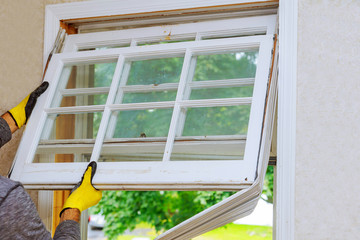
Learning how to measure for replacement windows is an important first step if you are planning to upgrade old, damaged, or drafty windows. Measuring may look simple, but even a small mistake can affect the fit, sealing, energy efficiency, and final installation. To measure correctly, you need to check the window width, height, and depth from the existing window opening.
You should also measure each window separately because two windows that look the same can still have slightly different sizes. Homeowners can take basic measurements to plan a project, compare options, or request an estimate. However, final measurements should always be confirmed by a professional window contractor before ordering replacement windows. This helps avoid gaps, air leaks, installation delays, and costly ordering mistakes.
Quick Answer: How Do You Measure for Replacement Windows?
The easiest way to understand how to measure for replacement windows is to start with width, height, and depth. Measure the window width from side jamb to side jamb in three places: top, middle, and bottom. Then measure the height from the sill to the top of the window frame in three places: left, center, and right. Use the smallest width and smallest height as your main measurements. You should also check the window depth and measure each window separately before replacing or ordering new windows.
Replacement Window Measurement Overview
| Measurement | Where to Measure | How Many Times | Which Number to Use |
|---|---|---|---|
| Width | From left jamb to right jamb | 3 times | Smallest width |
| Height | From sill to top/head jamb | 3 times | Smallest height |
| Depth | From inside frame to outside frame area | 1–2 times | Confirm with contractor |
| Diagonal | Corner to opposite corner | 2 times | Compare both diagonals |
| Each Window | Every window separately | Individually | Do not assume same size |
This table gives you a simple overview of how to measure for replacement windows before starting your project.
Why Accurate Window Measurements Matter
Accurate window measurements are important because replacement windows need to fit tightly inside the existing window opening. If the window is too large, it may not fit at all. If it is too small, it can leave gaps around the frame.
Poor measurements can lead to several problems, including:
- Air drafts: Gaps around the frame can let outside air enter your home.
- Water leaks: Poor-fitting windows can allow moisture to get behind the frame.
- Energy loss: Drafty windows can make heating and cooling less efficient.
- Noise problems: Gaps around the window can reduce sound insulation.
- Installation delays: Incorrect measurements may require reordering or extra repair work.
- Higher costs: Mistakes can increase labor, material, and project costs.
Correct measurements help your contractor choose the right window size, prepare the opening properly, and install the window with a clean seal. This is especially important for older homes, where frames may be uneven, settled, or slightly out of square.
Tools You Need Before Measuring a Window
Before you start, keep a few basic tools ready. You do not need professional equipment for basic window measurements, but accuracy matters.
Useful tools include:
- Metal measuring tape: Gives more accurate measurements than a soft tape.
- Notepad or phone: Helps you record each window size clearly.
- Pencil: Useful for labeling windows by room.
- Step ladder: Helps you safely reach taller windows.
- Level: Helps check if the frame is straight.
- Phone camera: Useful for taking photos of frame damage, trim, or older window details.
Take your time and write down each measurement carefully. If possible, label every window by room so your contractor can understand the project clearly.
How to Measure for Replacement Windows Step by Step
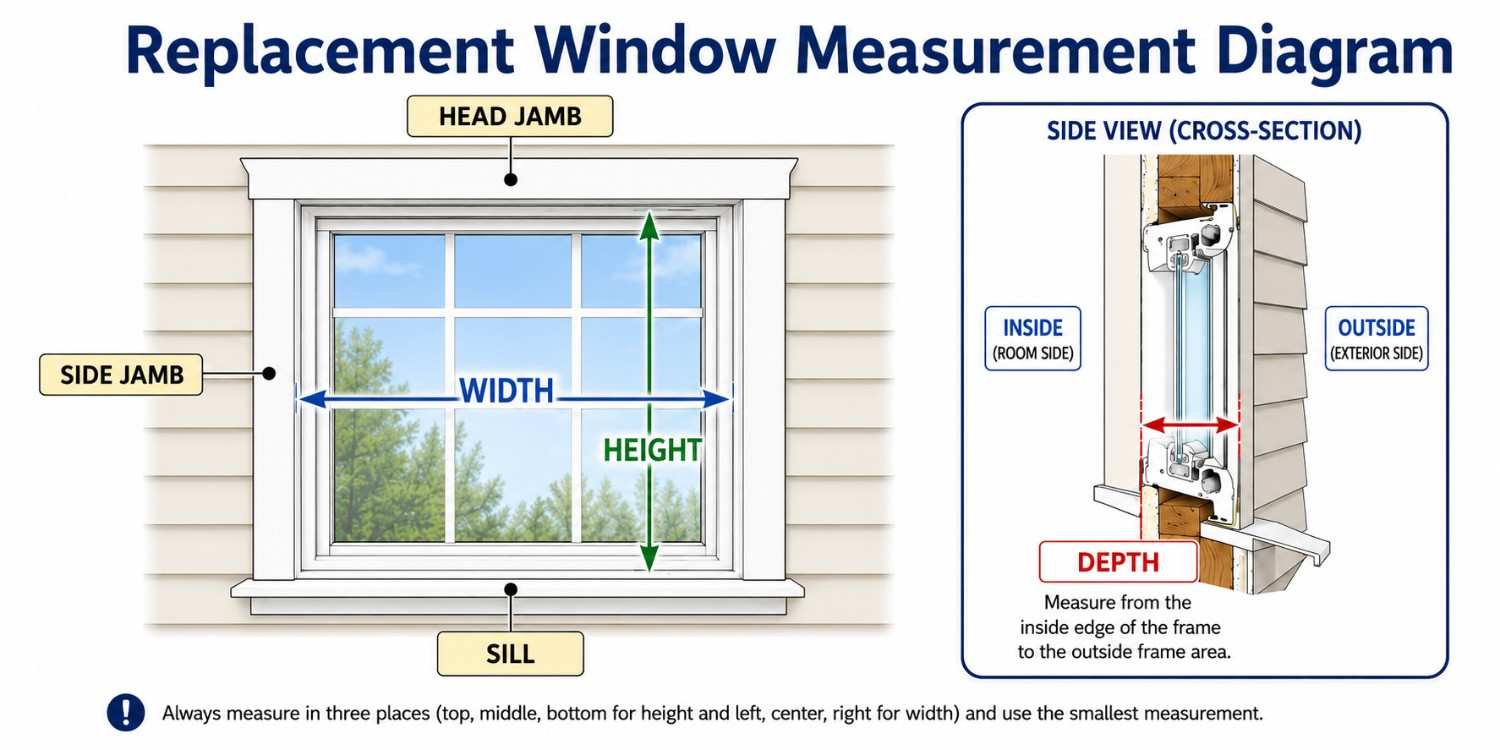
When learning how to measure for replacement windows, remember that you are not measuring only the glass. You are measuring the existing window opening where the replacement window will fit. The three main measurements you need are width, height, and depth.
Step 1: Measure the Window Width
Start by measuring the width from inside the frame. Measure from the left side jamb to the right side jamb. The jamb is the vertical side part of the window frame.
Take three width measurements:
- Top width: Measure across the top part of the window opening.
- Middle width: Measure across the center of the window.
- Bottom width: Measure across the lower part of the window opening.
Write down all three numbers and use the smallest one. This is important because the frame may not be perfectly even, especially in older homes.
For example, if your measurements are 36 inches, 35 ⅞ inches, and 36 inches, use 35 ⅞ inches as the window width.
Step 2: Measure the Window Height
Next, measure the height from the sill to the top of the window opening. The sill is the lower part of the window frame, and the top frame is often called the head jamb.
Take three height measurements:
- Left side: Measure from the sill to the top frame.
- Center: Measure from the middle of the sill to the top frame.
- Right side: Measure from the sill to the top frame.
Again, use the smallest number. This helps make sure the replacement window will fit properly inside the opening.
Do not measure from the interior trim or outside casing. Trim pieces are not always part of the actual window opening, and using them can give you the wrong size.
Step 3: Measure the Window Depth
Window depth is the space from the inside edge of the window frame to the outside edge where the new window will sit. Many homeowners forget this step, but it matters.
Check the depth because:
- The replacement window needs enough frame space.
- Some older windows may have shallow openings.
- Extra trim or frame work may be needed.
- The installer needs to know how the window will sit inside the opening.
To check the depth, open the window and measure the frame space from front to back. Avoid including trim, stops, or decorative pieces in this measurement. If you are not sure how to measure the depth, take a photo and let a contractor confirm it before ordering anything.
Step 4: Check If the Window Is Square
A window opening should be square, but many are slightly uneven. This is common in older homes because frames can settle, shift, swell, rot, or warp over time.
To check if a window is square:
- Measure diagonally from the top left corner to the bottom right corner.
- Measure diagonally from the top right corner to the bottom left corner.
- Compare both measurements.
If both diagonal measurements are close, the window opening is fairly square. If they are very different, the frame may need adjustment before installation.
Step 5: Measure Every Window Separately
Do not assume all windows are the same size. Even windows in the same room can have small differences in width, height, depth, or frame condition.
Label your measurements clearly, such as:
- Living room front window
- Kitchen window
- Bedroom left window
- Bedroom right window
- Bathroom window
This makes it easier for your contractor to understand the project and prepare an accurate estimate.
Special Considerations for Older Homes
Older homes need extra attention when learning how to measure for replacement windows because the window openings are not always perfectly straight. Over time, the framing can shift, settle, or wear down. Moisture can also damage the sill, jambs, or surrounding wood, which may affect the final window fit.
Pay close attention to:
- Frame movement: The opening may be slightly uneven because of settling.
- Worn sill areas: Soft or sloped sills can affect the final window fit.
- Hidden moisture damage: Paint or trim can hide rotten wood underneath.
- Non-standard sizing: Older windows may not match modern stock window sizes.
- Thick trim or plaster walls: These can make the actual opening harder to identify.
In an older home, measurements alone are not always enough. The condition of the frame matters just as much as the size. If the window sticks, leaks, or has soft wood around it, the opening may need repair before a replacement window is installed.
Replacement Window Measurement Mistakes to Avoid
When learning how to measure for replacement windows, small mistakes can lead to poor fit, air leaks, water problems, or extra installation costs. Here are the most common mistakes homeowners should avoid:
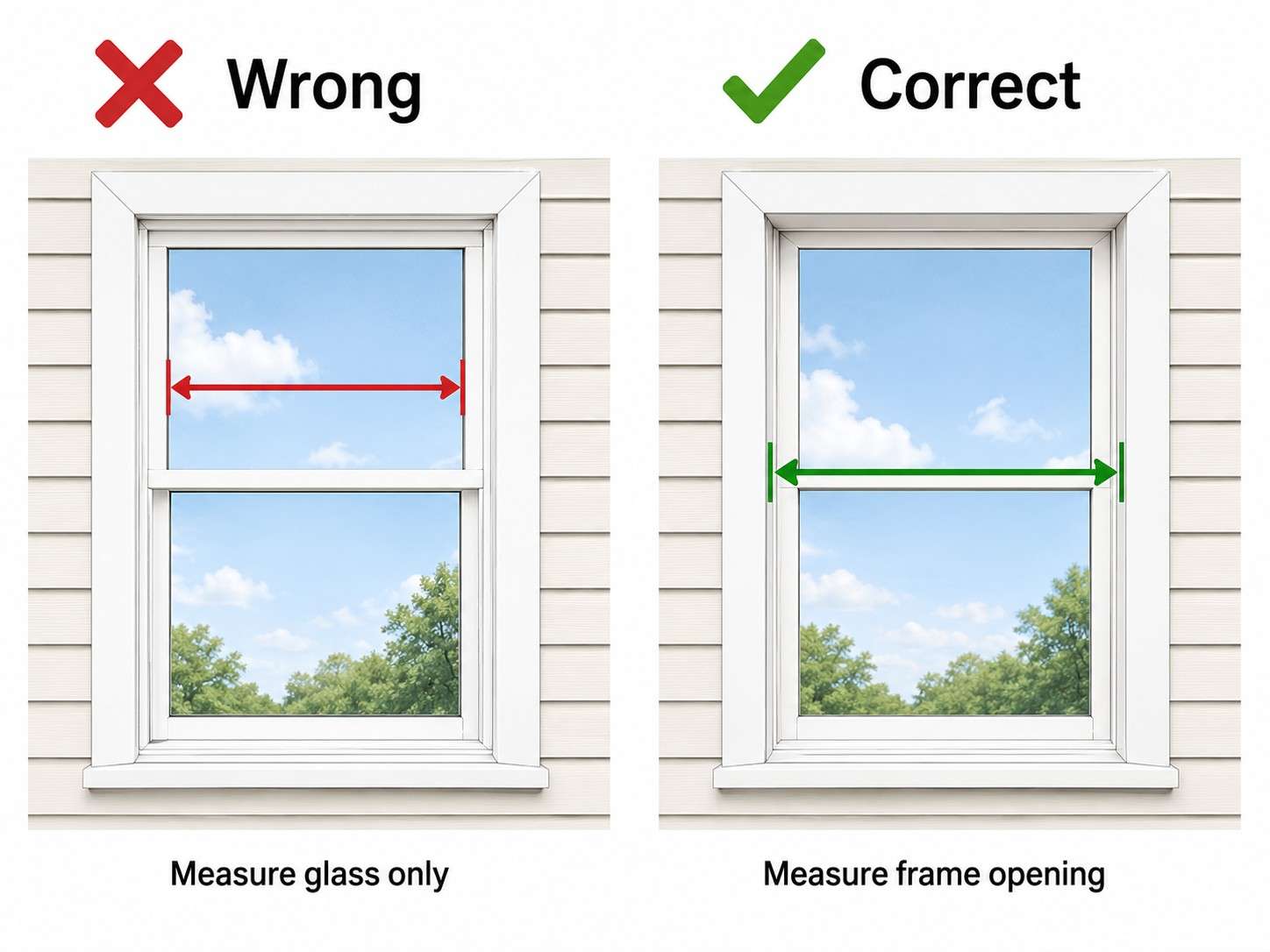
- Measuring only the glass instead of the window frame
- Measuring the trim instead of the actual opening
- Taking only one width or height measurement
- Using the largest measurement instead of the smallest
- Assuming all windows are the same size
- Forgetting to measure window depth
- Rounding measurements too much
- Ignoring signs of rot, water damage, or frame movement
- Ordering windows before a contractor confirms the size
A good rule is simple: measure carefully for planning, but do not order replacement windows until a professional verifies the final measurements.
When Is It Time to Replace Your Windows?
If you are already measuring your windows, it is also worth checking their condition. Some windows may only need minor repair, while others may need full replacement.
You may need replacement windows if you notice:
- Drafts around the window frame
- Condensation between glass panes
- Windows that are hard to open or close
- Soft, rotten, or damaged wood
- Water stains near the sill or wall
- Higher heating or cooling bills
- Outside noise coming through easily
- Cracked glass or broken seals
- Visible gaps around the frame
These signs do not always mean every window needs replacing, but they do show that a professional inspection is a smart next step.
Local Window Replacement Help from a General Contractor
If you are planning a window replacement project in Maryland or Virginia, United Developers can help inspect your existing windows, confirm accurate measurements, and replace them properly.
Our team handles window inspection, removal, installation, sealing, trim work, and cleanup. Whether you need to replace one damaged window or upgrade several windows, working with a professional general contractor helps avoid poor fit, leaks, drafts, and installation problems.
For window replacement help in Maryland and Virginia, contact United Developers to schedule an estimate.
Conclusion
Knowing how to measure for replacement windows helps you plan your project with more confidence. The main steps are simple: measure the width, measure the height, check the depth, use the smallest measurements, and measure every window separately.
Still, homeowner measurements should be used for planning only. Before ordering new windows, always ask a professional contractor to confirm the final measurements and inspect the window opening. This helps prevent poor fit, air leaks, water damage, and unnecessary costs.
Ready to Transform Your Space?
Contact Us Today!
Get in touch with our team today for trusted service.




Trusted by 50+ businesses across Maryland & Virginia.