Reviewed by Mohammad KhanCo-owner, United DevelopersMHIC #111971
What is roof decking, and how do I stop deck repair becoming a surprise bill?
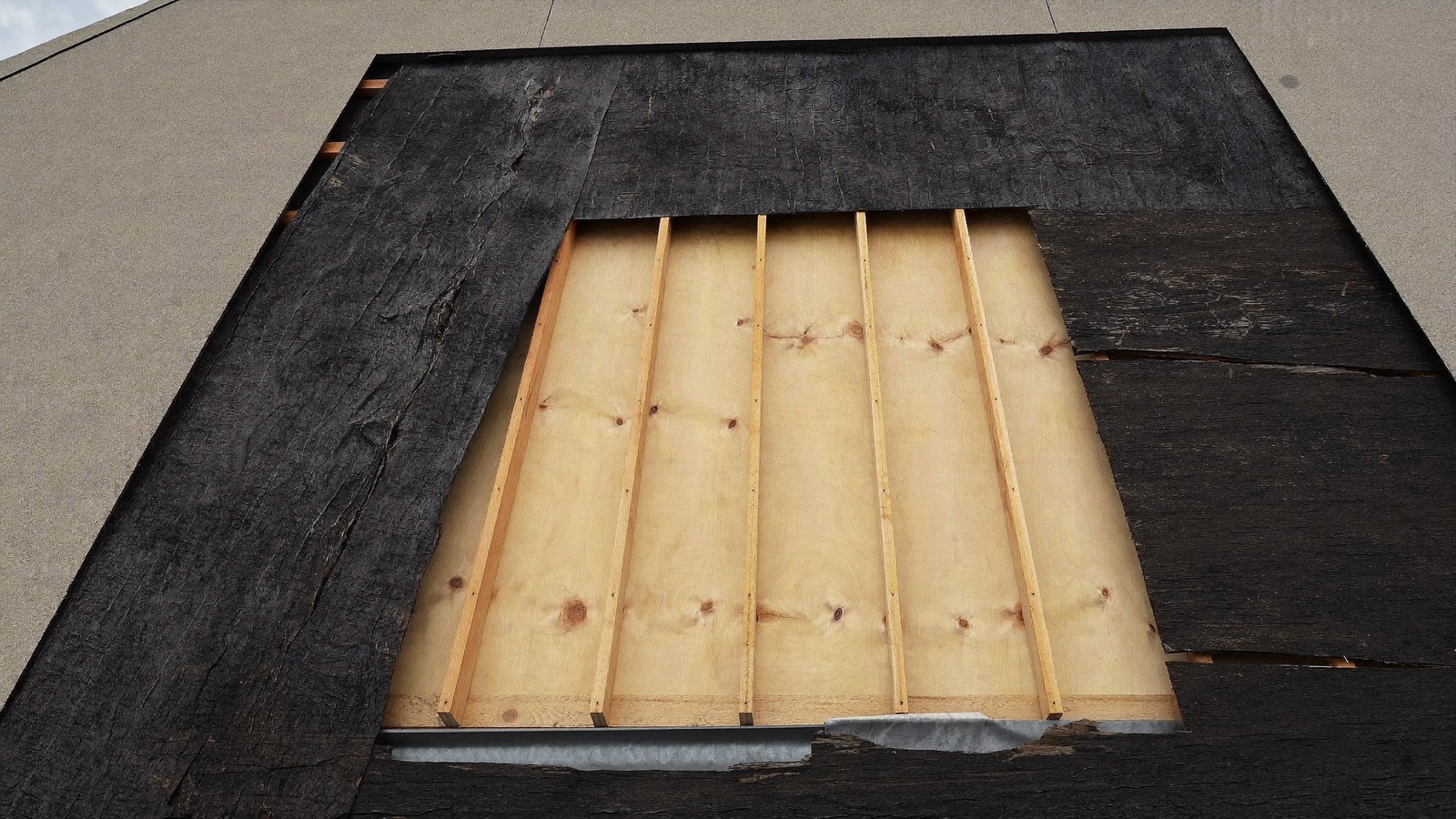
The deck, or sheathing, is the structural surface that every other roofing layer is fastened to — usually 7/16 inch or 1/2 inch OSB or plywood, and on older DMV houses often 1x6 or 1x8 plank boards with gaps between them. Shingles cannot be stronger than what holds their nails: a fastener has to pass through the sheathing or penetrate at least 3/4 inch into it, and a nail into soft, delaminated or gapped material holds nothing at all. Deck condition can only be fully known once the old covering is off, so the protection is contractual rather than technical: agree a per-sheet replacement price in writing before work starts, and require a photograph of every sheet replaced.
What the deck is, and what it is doing
The deck spans between your rafters or trusses and turns them into a continuous surface. Structurally it braces the frame and carries load — snow, wind uplift, a crew walking on it. Functionally, it is the substrate: every nail in every shingle, every flashing screw, every vent fastener terminates in this material.
That makes deck condition the ceiling on the performance of everything above it. A shingle with a published 130 mph wind rating achieves that rating with a specified number of fasteners, driven in a specified zone, into sound sheathing. Change the last variable and the rating is theoretical. This is also why the model residential code specifies fastener penetration: nails must pass through the sheathing or, on thicker material, penetrate not less than 3/4 inch into it.
The three deck types you find in the DMV
| OSB | Plywood | Plank / board sheathing | |
|---|---|---|---|
| What it is | Oriented strand board: wood strands bonded in cross-oriented layers, commonly 7/16 or 1/2 inch. | Cross-laminated wood veneers, commonly 1/2 to 3/4 inch. | Solid boards, typically 1x6 or 1x8, laid across the rafters with gaps between them. |
| Where you find it | Most construction from roughly the late 1970s onward. | Mid-century through to today, and common on better-built homes. | Older housing stock — the pre-war and early post-war DMV. |
| How it fails | Edges swell and the strands separate once it has been chronically wet. It rarely recovers. | Delaminates ply from ply, usually starting at an edge or a penetration. | Splits, cups, and works loose. The gaps between boards widen as the boards shrink with age. |
| Fastener behaviour when sound | Holds well when dry and intact. | Best of the three. | Excellent in the board, nothing at all in the gap. |
| What a re-roof needs | Replace swollen or soft sheets. Check the eaves and around every penetration first. | Replace delaminated sheets; sound plywood is worth keeping. | Often re-sheathing over the boards, because the gaps mean a proportion of fasteners land in air. |
On plank decking: shingle manufacturers set requirements for the substrate they will warrant, and wide gaps between boards are a common reason a re-sheath is specified rather than optional. If your house has plank decking, this is a conversation to have before the quote is written, not after the roof is open.
How deck failure shows up
Soft or spongy underfoot
A section that flexes when walked. The most reliable field indication of failure, and the reason nobody should be walking their own roof to check.
Fails when: It has usually been wet for years by the time it is soft.Delamination at the eaves
The overhang is the coldest part of the deck and the place ice dams put standing water. Plywood separates ply from ply; OSB swells at the edge.
Fails when: Frequently found only at tear-off, because the shingles above it still look intact.Rot around penetrations
Pipe boots, skylight curbs and old satellite mounts leak slowly. The water lands on the deck and stays there.
Fails when: A cracked pipe boot can wet the same square foot of sheathing for a decade before a ceiling stain appears.Sag between rafters
A visible dip in the roof plane between framing members, seen best from across the street in raking light.
Fails when: Indicates the sheathing has lost stiffness, or that a repeated load has overcome it.Nail pops
Fasteners backing out and lifting the shingle above them, often from a deck that has repeatedly swelled and dried.
Fails when: Each popped nail is a hole and a lifted tab in the same place.Daylight and staining in the attic
Light through the boards, dark tide marks on the underside, frost on nail points in winter, or mould bloom.
Fails when: Staining without an active leak usually means condensation, which points at ventilation.The layover question: a second layer over the first
A layover — installing new shingles over the existing ones instead of tearing off — is cheaper on the invoice and more expensive over the life of the roof. Three reasons.
- It hides the deck. Nobody can inspect sheathing they never uncover. Every problem in the section above stays in place, under a new roof you just paid for.
- It changes the thermal behaviour. Two layers of asphalt hold more heat than one, and heat is what ages asphalt. It also makes the fastening depth different from what the shingle was tested with.
- It telegraphs. The new shingles follow the contours of the old ones, including their cupped and lifted edges, so the finished roof is neither flat nor sealed the way it was designed to be.
The model code permits at most two total layers of roof covering, and it prohibits recovering over a surface that is water-soaked, deteriorated or buckled at all. So a layover is not automatically wrong — but on a roof whose deck condition is unknown, it is a decision to stay ignorant.
The one clause that protects you: the per-sheet price
Here is the honest part, and any roofer who tells you otherwise is guessing: nobody can promise you a final deck-repair quantity before tear-off. Sheathing hides under the roof covering. An inspection finds the likely trouble spots — eaves, valleys, penetrations, anywhere the attic showed staining — but the full picture arrives when the old roof comes off.
That uncertainty is normal. What is not normal is leaving it unpriced. A scope that says "deck repair as needed" in a fixed-price contract is an open invitation to a change order at the moment you have least leverage: your roof is open and the crew is on site.
What belongs in the contract
- A unit price per sheet of replacement sheathing, including labour, agreed before work starts
- The thickness and material that replacement sheets will be, matched to the existing deck and the rafter spacing
- A stated allowance if any is included, so you know when you are into extras
- A requirement that every replaced sheet is photographed, in position, before it is covered
- Who authorises quantities beyond the allowance, and how — in writing, not verbally from a ladder
- How re-sheathing over plank decking would be priced, if your house has board sheathing
This is also an insurance point. On an approved storm claim, deck replacement may or may not fall inside the scope your carrier has agreed, and that is your insurer’s determination to make. What a contractor can do is document the condition with photographs and submit it. On an approved claim, your deductible is typically your out-of-pocket cost, as determined by your policy and your carrier. See the claim process.
What we specify, and why
Deck condition is documented, priced and photographed — not discovered
The goal is that nothing about your deck is a surprise to either of us on install day, and that any figure that changes was agreed before it changed.
- Attic inspected for staining, daylight, frost points and sag before the quote is written
- Per-sheet unit price stated in the scope, including labour
- Replacement material and thickness named, matched to the existing deck
- Every replaced sheet photographed in position before it is covered
- Written authorisation for anything past the stated allowance
- Plank-deck re-sheathing priced separately where board sheathing is present
- Fastener pattern and penetration per the shingle manufacturer, into sound sheathing only
- Tear-off, not layover, as the default — so the deck is actually seen
How to tell whether a contractor is cutting this corner
The four most expensive words in a roofing contract. No quantity, no unit price, no authorisation process — and the conversation happens with your roof open.
Ask instead: what is the per-sheet price, and what allowance is included?Offered before anyone has looked at the deck. A layover is a decision to leave sheathing condition unknown for another twenty years.
Ask instead: what is in the attic, and what would tear-off price be for comparison?Possibly true and entirely unverifiable after the fact. Deck quantities are the classic place a job grows.
Ask instead: for a photograph of each replaced sheet, in position, before it is covered.Sheathing is under the shingles and visible from the attic side only. A verdict from the driveway is not a verdict.
Ask instead: did you go into the attic, and what did the underside look like?On plank decking a proportion of fasteners land in the space between boards and hold nothing. That is a wind-performance problem, not a cosmetic one.
Ask instead: what does the shingle manufacturer require as a substrate, and does this deck meet it?Then it can be written down. A genuinely all-inclusive deck allowance is easy to state in a sentence.
Ask instead: for that sentence, in the contract, with a number in it.Decking questions DMV homeowners ask
How do I know if my roof deck is rotten?
From inside the attic, not from the roof. Look for dark tide marks or bloom on the underside of the sheathing, daylight visible between boards, frost or rust on protruding nail points in winter, and any visible dip in the plane between rafters. From the street, raking evening light shows sag and waviness that midday sun hides. What you should not do is walk the roof yourself to feel for soft spots: a deck weak enough to detect underfoot is a deck weak enough to fail under you.
Should deck replacement be priced before the work starts?
Yes, as a unit price. Nobody can honestly promise a final quantity before tear-off, because sheathing sits under the roof covering — but the price per sheet, the material and thickness being used, any allowance included, and who authorises quantities beyond it can all be agreed in writing beforehand. A fixed-price contract that says only deck repair as needed leaves the number open at the exact moment you have least leverage: your roof is open and a crew is standing on it.
Can you shingle over plank decking with gaps between the boards?
Sometimes, and often not. Fasteners that land in a gap hold nothing, so a deck with wide or widening board gaps puts a share of every shingle course into air — which is a wind-performance problem rather than a cosmetic one. Shingle manufacturers set substrate requirements for the roofs they will warrant, and re-sheathing over the boards is a common condition rather than an upsell. If your house has plank sheathing, settle this before the quote is written.
Is a second layer of shingles over the first ever acceptable?
The model code permits at most two total layers and prohibits recovering over any surface that is water-soaked, deteriorated or buckled, so a layover is not automatically wrong. It is, however, a decision to leave the deck unseen: no one can inspect sheathing they never uncover. A layover also holds more heat than a single layer, which is what ages asphalt, and it follows the contours of the old shingles rather than lying flat. On a roof whose deck history includes attic staining or known leaks, tear-off is the honest choice.
Why did my roofer find rot when nothing was leaking inside?
Because a wet deck and a wet ceiling are different events. A cracked pipe boot, a lifted flashing or a chronically damp attic can wet the same area of sheathing for years while the water never reaches drywall — it soaks into the wood, spreads, and evaporates. Condensation from unbalanced ventilation does the same thing across a much wider area, wetting the underside of the deck every cold night without a single drop coming through. That is why the attic inspection matters as much as the roof surface.
Where to go next
A sound deck and a breathing attic still leak if the roof stops badly. Next: the metal that carries water across every junction, and the components at the edges and the peak.
Flashing and penetrations
Step, kick-out, apron, counterflashing, crickets, valleys and boots — named, with what fails in each.
Read the standard →UnderlaymentUnderlayment: synthetic, felt and membrane
What goes on the deck before the shingles, and the five places membrane is not optional.
Read the standard →ServiceRoof replacement in Maryland
Tear-off by default, per-sheet deck pricing in the scope, every replaced sheet photographed.
See the service →ToolInstant satellite roof quote
A real ballpark measured from your actual roof, at current DMV rates.
Price my roof →The serviceRoof replacement
GAF architectural shingle or standing-seam metal, full tear-off, corrected ventilation, and a written line-item price first.
See the service →