Reviewed by Shaw ChannaCo-owner, United Developers
How does a hail damage roof insurance claim work?
You report the loss with a date, an adjuster chalks a test square on each slope and counts impact marks against the carrier threshold, and the settlement is written line by line. On an approved claim your deductible is typically your out-of-pocket cost. A replacement is priced off your ZIP and a measured roof.
The claim, step by step
The hail damage roof insurance claim process
The order matters. Most claims that go badly went badly at step two or step three, before anybody disagreed about anything.
- Establish the date Hail claims are event-based. Note the date of the storm, keep any local reports or weather records, and photograph anything on the ground that day — dented gutters, a bruised air-conditioning condenser, damage to a fence or a car.
- Get an independent documented inspection first Before you call the carrier, have the roof inspected and photographed slope by slope, so the claim begins with evidence rather than with a question. A report that also records pre-existing wear as wear is more credible, not less.
- Report the loss promptly Policies require prompt notice. Late reporting is one of the most common grounds on which a legitimate claim is questioned, because hail evidence weathers and another storm can pass through in the meantime.
- Meet the adjuster on site Be there. The adjuster will chalk a test square, usually 10 feet by 10 feet, on each slope and count impact marks inside it against the carrier own threshold. Have your inspection report and photographs in hand so the same evidence is in front of both parties.
- Read the scope, not just the total The settlement arrives as a line-item estimate. Check that it includes everything the job needs: tear-off, underlayment, ice barrier, all the flashing, ventilation, permit and disposal. Missing line items are the normal reason a settlement is short.
- Supplement where the scope is incomplete A supplement is a documented request for line items the original scope missed, supported by photographs and by code requirements. It is a normal part of the process rather than a dispute.
- Understand what is held back Most claims settle at actual cash value first, with the recoverable depreciation released after the completed work is documented. Your deductible is subtracted from what you receive and is your out-of-pocket cost.
Why hail damage is bad for a roof, when there is no hole
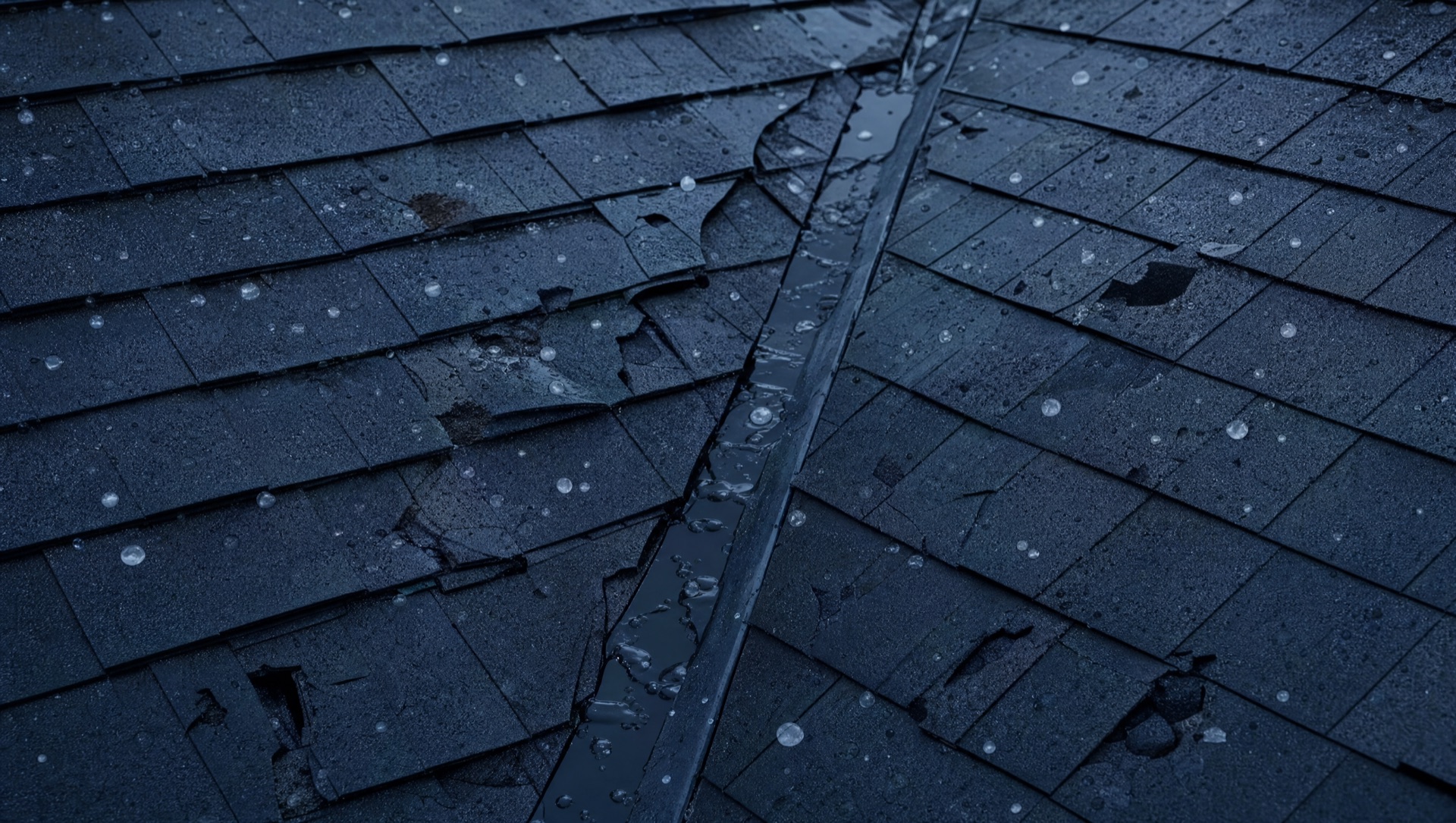
Hail damage on asphalt looks like a scattered pattern of roughly circular spots where granules have been knocked away, with a soft bruise or fracture in the mat beneath that is easier to feel than to see. There is normally no hole and no immediate leak, which is exactly why homeowners under-report it and why it matters anyway.
The damage is to the two things keeping the shingle alive. The granule layer is the sun protection: strip it and the asphalt beneath oxidises and dries far faster than it should. The fracture in the mat is a stress line that will open with freeze-thaw cycling. So a hailed roof does not leak this month, it leaks in three or four years, and by then the event is impossible to claim. That gap between the damage and the consequence is the whole reason hail claims exist as a category.
No, hail does not always damage a roof. It depends on stone size and density, the angle of arrival, the slope and orientation of each plane, and above all how brittle the shingles already were. The most useful check a homeowner can make is the soft metal around the property — gutters, vent hoods, the condenser fins, the garage door. If none of that is dented, be sceptical of anyone telling you the roof is destroyed.
Denials, and what to do about one
- Read the reason. A denial letter states grounds: no covered damage found, damage below the threshold, wear and tear, late reporting, or a cosmetic-damage exclusion on the policy. Each has a different answer.
- Cosmetic exclusions are real. Some policies exclude damage that is aesthetic rather than functional, most often on metal roofs. That is a policy term rather than an adjuster opinion, and it is worth checking your declarations page before arguing.
- Ask for re-inspection with your own documentation present. Bring the dated photographs and a line-item scope. Most reversals come from evidence that was not in front of the adjuster the first time, not from persistence.
- A licensed engineer report is the escalation where a claim genuinely turns on whether the damage is functional. It costs several hundred dollars and up, and it is paid by you.
- Maryland has an insurance regulator. The Maryland Insurance Administration takes complaints about claim handling, and its existence is often enough to get a file re-examined.
- Be honest with yourself about age. A twenty-five-year-old roof with scattered bruising is a hard claim and always was. A denial there is not a scandal, and spending money fighting it is usually worse value than spending it on the roof.
Documenting damage and providing a scope is a contractor job. Negotiating your claim on your behalf is adjusting, which is a licensed activity, and a document that assigns your claim or commits you to use one company regardless of the outcome is a document to read very carefully before signing.
Ask instead: Is this an authorisation to inspect, or a contract for the work, or an assignment of my claim? I want to know which.That is inflating an insurance estimate to cover a deductible, which is fraud, and the policyholder name on the claim is yours. Maryland law is explicit that a contractor may not pay, waive, rebate or absorb a deductible.
Ask instead: Nothing. That is the end of the conversation.Hail claim questions
How does the hail damage roof insurance claim process work?
You establish the date of the storm, get the roof documented and photographed, report the loss promptly, and meet the adjuster on site. The adjuster chalks a test square on each slope, typically ten feet by ten feet, and counts impact marks inside it against the carrier own threshold. If the count qualifies, a line-item settlement is written. Most claims settle at actual cash value first, with recoverable depreciation released once the completed work is documented, and your deductible is subtracted from what you receive.
Can a hail damaged roof be repaired?
Often, yes. Scattered functional damage on one slope of a reasonably young roof whose shingle is still available is a repair, and any honest contractor should be willing to say so. Widespread bruising across every plane of a roof well into its second decade generally is not, because the money extends something that was nearly finished before the storm and the surrounding shingles crack when they are lifted. The wrong answers run in both directions: insisting every hailed roof must be replaced, and patching a comprehensively bruised roof knowing the call-back lands on somebody else.
Why is hail damage bad for a roof if it does not leak?
Because it removes the granule layer that protects the asphalt from sunlight and it fractures the mat underneath. Neither produces a hole, so nothing leaks in the first season. What happens instead is that the exposed asphalt oxidises and dries several times faster than it should, and the fractures open with freeze-thaw cycling, so the roof fails years earlier than it would have. By the time it leaks, the storm is too old to claim. That delay is precisely why hail is treated as a covered sudden loss rather than as maintenance.
What if my hail claim is denied?
Read the stated grounds first, because each has a different answer. Damage below the threshold or none found is answered by a re-inspection with your own dated photographs and a line-item scope in front of the adjuster. Wear and tear on an old roof is often a fair call. A cosmetic-damage exclusion is a policy term rather than an opinion and should be checked on your declarations page. Where the claim genuinely turns on whether damage is functional, a licensed engineer report is the escalation, and the Maryland Insurance Administration takes complaints about claim handling.
Does filing a hail claim raise my premium?
A weather-related claim is generally treated differently from an at-fault one, but claims history does form part of how a policy is rated and repeatedly claiming can affect renewal terms in this market. The bigger risk on an old roof is different: some carriers move older roofs onto actual cash value settlement or decline to renew regardless of claims. That is an argument for getting a documented inspection so you know what you have, rather than an argument for not reporting real damage.
Can hail damage roof decking?
Very rarely, and not in the way homeowners picture. Hail large enough to break through shingles and mark the sheathing beneath is an extreme event. What far more commonly damages decking is what follows hail: a compromised shingle surface that lets water reach the deck over the following years, which is why the deck is inspected on every replacement and why a per-sheet rate for rotten sheathing belongs in the contract before the roof is opened.
Where to go next
These are the pages that cover the rest of the claim and the roof it pays for.
The roof insurance claim, start to finish
ACV against RCV, the adjuster meeting, supplements, and the Maryland deductible rule.
Read the standard →Spotting itHow can you tell if your roof has hail damage?
Soft metal records the strike; on shingles the marker is a random bruise, not a hole. What counts and what does not.
Read the answer →DenialsWhat to do if your roof claim is denied
The four reasons carriers state, which of them is commonly reconsidered, and when to stop.
Read the answer →EscalationDo I need a lawyer for a roof insurance claim?
Four roles get confused here. Most denials are an evidence problem, not a legal one.
Read the answer →The serviceStorm and insurance restoration
Damage photographed and dated in the format adjusters expect, and we meet your adjuster on the roof.
See the service →