Reviewed by Shaw ChannaCo-owner, United Developers
How does a roof insurance claim actually work from start to finish?
In sequence: document the damage promptly after the storm with dated photos, have the roof professionally inspected so you know whether a claim is even warranted, then file with your carrier — you, the policyholder, file and own the claim. The carrier assigns an adjuster who inspects the roof; your contractor should be present with the photo evidence and a line-item scope so nothing legitimate is missed. The carrier then issues an estimate and, on a replacement-cost policy, a first check for the actual cash value of the roof — the depreciated amount — with the recoverable depreciation paid after the work is completed. Items the adjuster’s estimate missed are requested as supplements with photo and code documentation. Your deductible is subtracted from the payout and is typically your out-of-pocket cost on an approved claim, and in Maryland a contractor offering to pay or waive it is committing insurance fraud. The whole path ordinarily runs weeks to a few months.
What your policy actually owes — and in which order
A homeowner policy is an indemnity contract: after a covered peril — hail, wind, a fallen tree — it owes you restoration to your pre-storm position, minus your deductible. It does not owe you a nicer roof than you had, and it owes you nothing for wear and age, which are excluded on standard policies. Between those two boundaries sits everything worth knowing.
ACV, RCV and recoverable depreciation — the three-number game
Replacement cost value (RCV) is what it costs to replace your roof today. Actual cash value (ACV) is RCV minus depreciation for the roof’s age and condition. If your policy covers the roof at RCV — most do, but see below — the carrier still usually pays in two installments: first the ACV check, then the recoverable depreciation after you prove the work was completed, typically by invoice. Concretely: an $18,000 approved replacement on a 15-year-old roof might arrive as a $10,000 ACV check up front and $7,000 of depreciation after completion, with your $1,000 deductible making up the difference. Homeowners who do not know the second check exists sometimes never collect it.
Two policy questions decide most of the money, and both are answerable by your agent in five minutes: Is my roof covered at RCV or ACV? Some policies carry roof schedules or endorsements that move older roofs to ACV-only, which on an old roof can mean a payout far below replacement cost. And what is my wind-hail deductible? Many Maryland policies carry a separate wind-hail deductible set as a percentage of the dwelling coverage rather than a flat dollar amount — on a $500,000 dwelling limit, a 2% wind-hail deductible is $10,000, which changes whether a marginal claim is worth filing at all.
The process, in the order it actually happens
Document the event, that week
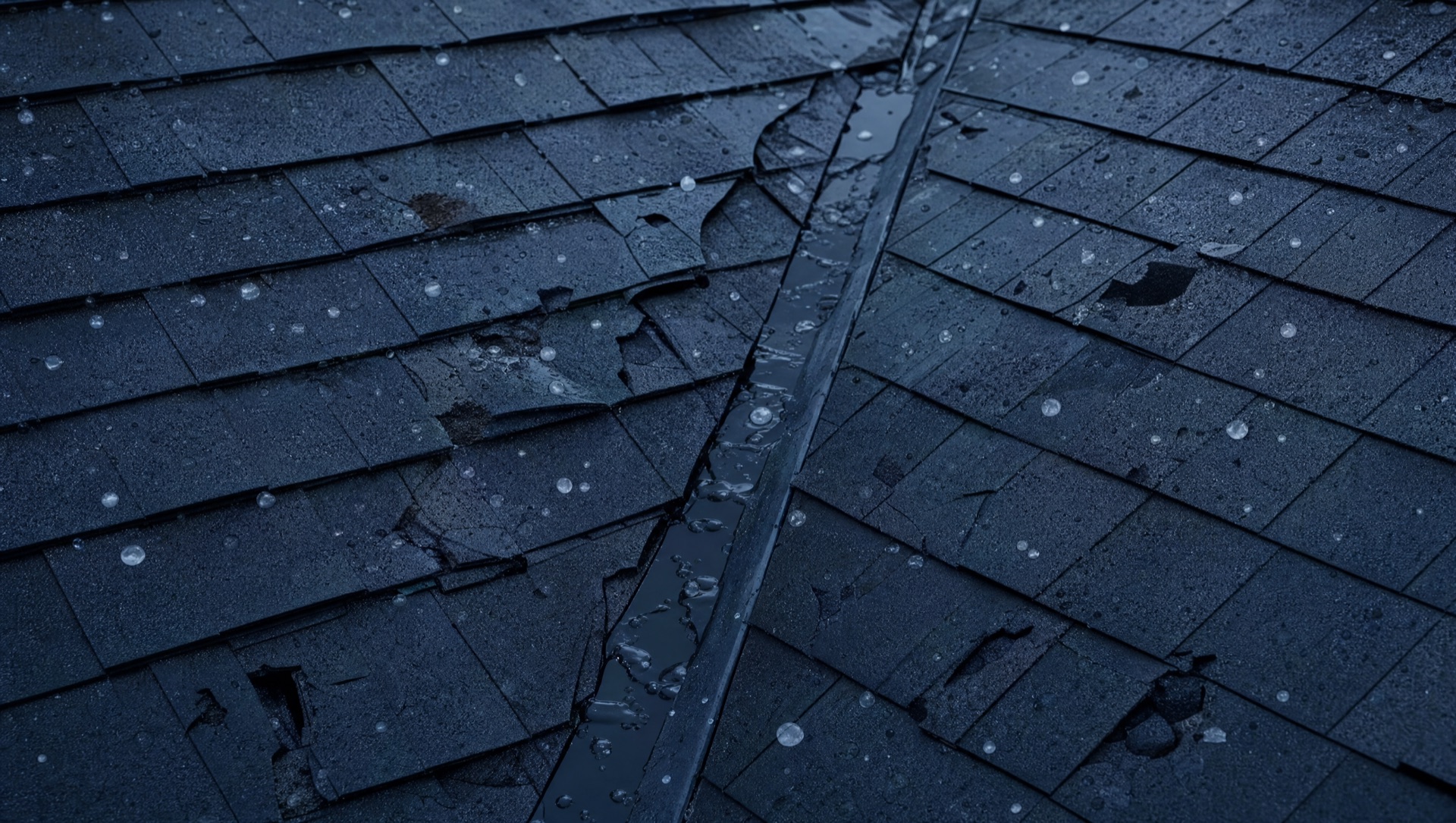
Date-stamped photos of the roof, gutters, downspout granule wash, dented soft metals (vents, flashing, mailbox, AC fins) and any interior symptoms. Note the storm date — public weather records will corroborate it. Cover any active leak with emergency tarping to stop further damage; carriers expect reasonable mitigation, and the reasonable cost of it is generally itself claimable.
Fails when: Waiting months blurs the storm-date link that separates covered damage from excluded wear. Policies also carry prompt-notice requirements and deadlines.Get a professional inspection before filing
An inspection answers the question that decides everything: is there enough legitimate storm damage to warrant a claim? Hail bruising and wind creasing have specific signatures an experienced roofer photographs and marks slope by slope.
Fails when: Filing a claim that gets denied still becomes part of your claims history. If the honest finding is “not enough damage to claim,” the right answer is a written report saying so — which is what our inspectors are instructed to produce.File the claim — you, not your contractor
You are the policyholder; you file, by phone or app, with the storm date and the documentation. You will receive a claim number and an adjuster assignment. From this point the carrier owes you acknowledgement and movement within the timeframes its own policy and state rules set.
Fails when: Signing paperwork that hands a contractor control of your claim — assignment-of-benefits or open-ended “authorization” documents — surrenders leverage you may want later. Have any such document read carefully before signing; you never need to sign one to get an inspection or a quote.The adjuster meeting — with your evidence present
The carrier’s adjuster inspects the roof, often chalking hail hits per test square. Your contractor should attend with the inspection photos and a line-item scope, because the adjuster writes the first draft of what gets paid — and a slope, a code item or an access cost that never enters that draft has to be argued in later. We meet the adjuster on-site as standard practice.
Fails when: An adjuster walking the roof alone, working from a 20-minute look, writes a 20-minute estimate. That is not malice; it is why the supplement process exists.The estimate and the first (ACV) check
The carrier issues a written line-item estimate and, on RCV policies, the ACV payment. Read the estimate line by line against your contractor’s scope: count of slopes, underlayment, flashing, ventilation components, disposal, steep or high access charges.
Fails when: Treating the first estimate as final. It is an opening document, revisable with evidence — carriers themselves expect supplements on roofing claims.Supplements: recovering what the first draft missed
A supplement is a documented request to add missed items: photographs, measurements, and — critically — code citations. If your jurisdiction’s adopted code requires ice barrier at the eaves, drip edge, or ventilation the old roof lacked, ordinance-or-law coverage in most policies pays for code-required items. Manufacturer installation requirements (starter, ridge cap) are supplementable the same way.
Fails when: Supplements without documentation are requests; supplements with photos, code sections and manufacturer specs are corrections. This is where a contractor who documents thoroughly earns their keep on a claim.The build, the invoice, the depreciation release
The roof is installed per the approved scope plus approved supplements. The final invoice goes to the carrier, which releases the recoverable depreciation — the second check. Keep the full file: estimate, supplements, invoice, warranty registration.
Fails when: The depreciation is released on proof of completion. Homeowners who pocket the ACV check and delay the work can find the depreciation forfeited under the policy’s time limits — and the roof still unrepaired before the next storm.If the claim is denied or short-paid
You can request a re-inspection with your contractor present, submit further documentation, invoke the appraisal clause most policies contain for disputes over the amount of loss, engage a licensed public adjuster or attorney, or complain to the state regulator — the Maryland Insurance Administration, which takes consumer complaints at no charge.
Fails when: Note who is missing from that list: your roofer. A roofing contractor is not licensed to negotiate your claim on your behalf — see the section below on who does what.The documentation that actually moves carriers
Claims are decided on files, not phone calls. Everything below is producible at inspection time for the cost of doing the job carefully, and each item maps to a dollar line the first estimate commonly misses.
- Dated, per-slope photo sets — overview, then close-ups of chalked hail strikes and wind creases, with a marker for scale. Corroborates the storm-date link and per-slope counts.
- Test squares — hits counted inside a marked 10-by-10-foot square per slope, the same convention adjusters use, so your evidence and theirs are directly comparable.
- Soft-metal damage photos — dents in vents, flashing and gutters cannot be attributed to wear and are the classic corroboration that hail of damaging size actually fell.
- A measured roof diagram — squares, pitch, eave and valley lengths, penetration count. Turns arguments about quantity into arithmetic.
- Code documentation — the adopted code sections requiring ice barrier, drip edge or ventilation on the replacement, cited by number for the ordinance-or-law line.
- Manufacturer requirements — the installation instructions requiring starter strips and matching ridge cap, which make those real line items rather than “extras.”
- Interior evidence, if any — dated photos of stains or wet insulation, tied to the same event.
Why we hand you this file free: the inspection report is yours to keep whether or not you hire us or file anything. An honest file sometimes says “not enough damage to claim” — and when it does, that finding protects you from the door-knocker who arrives promising otherwise.
Deductibles, fraud lines and who may negotiate — Maryland
Three rules protect Maryland homeowners, and knowing them is the cheapest fraud insurance available.
1. The deductible is yours, and “we will eat it” is the red flag
On an approved claim, your deductible is typically your out-of-pocket cost — that is how the contract is built. A contractor who offers to pay, waive, rebate or “absorb” the deductible is proposing to misrepresent the true cost of the job to your insurer, which is insurance fraud in Maryland — and the claim it corrupts has your name on it, not just theirs. United Developers never pays, waives or rebates a deductible, and we put that in writing. When a contractor opens with a waived deductible, the conversation is over; what else on that estimate is invented?
2. Only certain licenses may negotiate your claim
A roofing contractor may inspect, document, estimate, meet your adjuster and present evidence about the scope of repairs — that is our lane, and we stay in it. Negotiating the claim itself on your behalf — arguing coverage, settling amounts, representing you to the carrier — is public adjusting, which requires a separate license in Maryland. United Developers is a roofing contractor, not a public adjuster, and a roofer who markets themselves as a “claims specialist who will handle the whole claim for you” is describing unlicensed public adjusting. If a claim turns into a genuine dispute, the licensed paths are a public adjuster, an attorney, the policy’s appraisal clause, and the state regulator.
3. You have deadlines, and so does the carrier
Policies require prompt notice of loss and set time limits on completing repairs to collect depreciation — read yours for the numbers, and file promptly rather than testing them. In the other direction, carriers owe you timely acknowledgement, investigation and payment under each state’s unfair-claims-practices rules, and the Maryland Insurance Administration takes consumer complaints, free, when a claim stalls without explanation. Naming that option to a stalled carrier, politely, is frequently the last step a homeowner ever needs.
What we do on a claim — and what we refuse to do
On a storm claim, United Developers does the documentation — and only the documentation
The homeowner files and owns the claim. Our role is to make the file so complete that the honest outcome is the easy one:
- Free storm inspection, typically within 24 hours, with the honest verdict in writing — including “not enough damage to claim” when that is the finding
- Adjuster-ready photo documentation: per-slope sets, chalked test squares, soft-metal corroboration, measured diagram
- We meet your adjuster on-site and present the evidence and the line-item scope
- Supplements documented with photos, code sections and manufacturer specs — never padded, every line defensible
- The deductible stays yours — never paid, waived or rebated, stated in writing on our estimates
- No assignment-of-benefits demanded to get an inspection, a report or a quote — the report is yours either way
- No claim negotiation — we are not public adjusters, and if your dispute needs one, we will say exactly that
The post-storm sales pitch, decoded
After every hail event, crews sweep the affected ZIP codes. Some are legitimate; the ones that are not reuse the same five sentences. Each has a tell.
Deductible waiver is insurance fraud in Maryland, committed on a claim that carries your name. A contractor who opens with fraud as a favor will close with it as a habit.
Ask instead: them to leave. A legitimate claim plus your deductible is the honest version of this exact transaction.You file your own claim; no contractor needs a signed contract to inspect a roof, and same-day signature pressure exists to beat your second quote. Assignment-of-benefits language may be doing more in that document than the salesperson mentions.
Ask instead: for the inspection report and written scope first — and read any authorization document for assignment or cancellation terms before signing.“Handle everything” is the phrase to press on. Documenting and meeting the adjuster is contractor work; negotiating your claim is licensed public-adjuster work, and a roofer offering it is offering to practice without the license.
Ask instead: exactly which license they hold — an MHIC number verifies online in minutes — and who, by name, negotiates if the carrier disputes.Hail is real and neighborhood-wide claims are real; the tell is the promised outcome before anyone has been on your roof. Damage sufficient to claim is a finding, not a greeting.
Ask instead: for the per-slope photo evidence from your roof, and whether their inspection report will say so if the damage is insufficient.Your agent is the one party in the transaction with a duty to explain your own policy — the RCV-versus-ACV question and your wind-hail deductible are five-minute answers that change every downstream number. Isolating you from your agent only ever serves the person doing the isolating.
Ask instead: your agent those two questions before filing anything — and be suspicious of anyone who discourages it.Claim questions Maryland homeowners ask
What is the difference between ACV and RCV on a roof claim?
Replacement cost value is what it costs to put an equivalent new roof on today. Actual cash value is that number minus depreciation for the roof’s age and wear. On a replacement-cost policy the carrier typically pays in two stages — the ACV amount up front, and the recoverable depreciation after you show the work was completed — with your deductible subtracted. On an ACV-only policy or an ACV roof endorsement, the depreciated amount is all there is, which on an older roof can be a fraction of the real replacement cost. Which type of coverage your roof carries is a one-question call to your agent, and it is worth making before storm season rather than after.
Can a roofer pay or waive my insurance deductible in Maryland?
No. Paying, waiving, rebating or absorbing a homeowner’s deductible misrepresents the true cost of the work to the insurer, and it is insurance fraud in Maryland — on a claim filed under your name. The deductible is the policyholder’s share by contract, and on an approved claim it is typically your only out-of-pocket cost. United Developers never pays, waives or rebates deductibles, and deductible financing exists for homeowners who need the amount spread over time. Treat any waived-deductible offer as the end of the conversation with that contractor, because the offer tells you how the rest of their file is built.
Who actually files the insurance claim — me or the roofing company?
You do. You are the policyholder; the claim, the payouts and the decisions are yours, and any contractor who insists on filing or controlling the claim for you is taking something that belongs to you. The contractor’s legitimate role is evidence and scope: inspecting, photographing, producing the line-item estimate, meeting the adjuster on-site, and documenting supplements. That division of labor is also the law’s: negotiating claims on a homeowner’s behalf requires a public adjuster license in Maryland, which roofing contractors do not hold. Keep the claim in your name and the evidence in your file, and the process stays yours to steer.
What is a supplement, and why do roof claims so often need them?
A supplement is a documented request to add items the carrier’s first estimate missed. First estimates are written fast, often from a brief inspection, and roofing scopes hide real items in the details: ice barrier and drip edge the local code requires on the replacement, starter and ridge components the shingle manufacturer requires, steep-slope or second-story access charges, disposal, or a slope that was undercounted. Ordinance-or-law coverage in most policies pays for code-required items — but only if someone cites the code section and documents the condition. A supplement backed by photos, measurements and citations is routine; carriers process them constantly. An undocumented one is just a request for more money.
What can I do if my roof claim is denied or the payment seems too low?
In escalating order: request a re-inspection with your contractor present and the photo evidence on the table, since many disputes die at this step; submit supplements with documentation for specific missed items; invoke the appraisal clause most policies contain, where each side appoints an appraiser and disagreements go to an umpire; engage a licensed public adjuster or an attorney if the dispute is large; and file a consumer complaint with the Maryland Insurance Administration, which is free and gets stalled files reviewed. A roofing contractor cannot negotiate the claim for you — but the evidence file a thorough contractor builds is what every one of those paths runs on.
Where to go next
The claim pays for the roof; these guides cover what should then be installed on it — and the warranty paper that outlasts the claim file.
Filing the claim, step by step
The companion walkthrough of the filing itself — the calls, the paperwork and the meeting, in order.
Read the guide →WarrantyWhat a roof warranty actually covers
Manufacturer versus workmanship versus insurance — three different documents that homeowners are encouraged to confuse.
Read the standard →StormStorm damage and insurance claims in Maryland
The storm-restoration service page: inspection, documentation, adjuster meeting and build, as one process.
See the service →LeaksRoof leaks and storm damage
For active leaks: emergency tarping, then the leak traced and a repair-or-replace verdict in writing.
See the service →