Reviewed by Mohammad KhanCo-owner, United DevelopersMHIC #111971
How do shingles work on a roof?
Shingles shed water rather than seal it out. Each course overlaps the one below so water runs from one piece onto the next and off the edge, gravity doing the work. A heat-activated sealant strip bonds each course to the one beneath so wind cannot lift it. Our shingle roofs are priced off your ZIP and a measured roof.
Shedding, not sealing
Every steep-slope roof covering in history works the same way: small overlapping units, laid from the bottom up, each one covering the joint below it, with gravity moving the water down the stack and off the edge. Thatch, slate, tile and asphalt shingle are the same idea in different materials. Nothing about it is watertight in the way a bathroom floor is watertight, and it does not need to be, because water is never asked to sit still on it.
That is why pitch matters, why a shingle roof has a minimum slope below which it must not be used, and why every leak on a shingle roof happens somewhere the shedding logic breaks down — a penetration, a wall, a valley, an edge, or a place where wind drove water uphill faster than gravity could take it down.
The underlayment beneath the shingles is the backup, not the roof. It is there to protect the deck during construction and to catch what gets past a detail. If it is doing real work for years, something above it has failed.
What an asphalt shingle actually is
- The mat. A fibreglass mesh, which is the structure. Everything else is attached to it, and when a roofer says a shingle is brittle, the mat is what has aged.
- The asphalt. Saturating and coating the mat, this is the waterproofing. It dries out and oxidises over time, which is what ends the roof.
- The granules. Ceramic-coated mineral granules embedded in the top surface. They are not decoration — they are the sunscreen protecting the asphalt from UV, and losing them is the beginning of the end.
- The sealant strip. A band of adhesive that softens in the sun after installation and bonds each shingle to the course below. This is what makes a roof wind-resistant, and breaking it is what wind damage actually is.
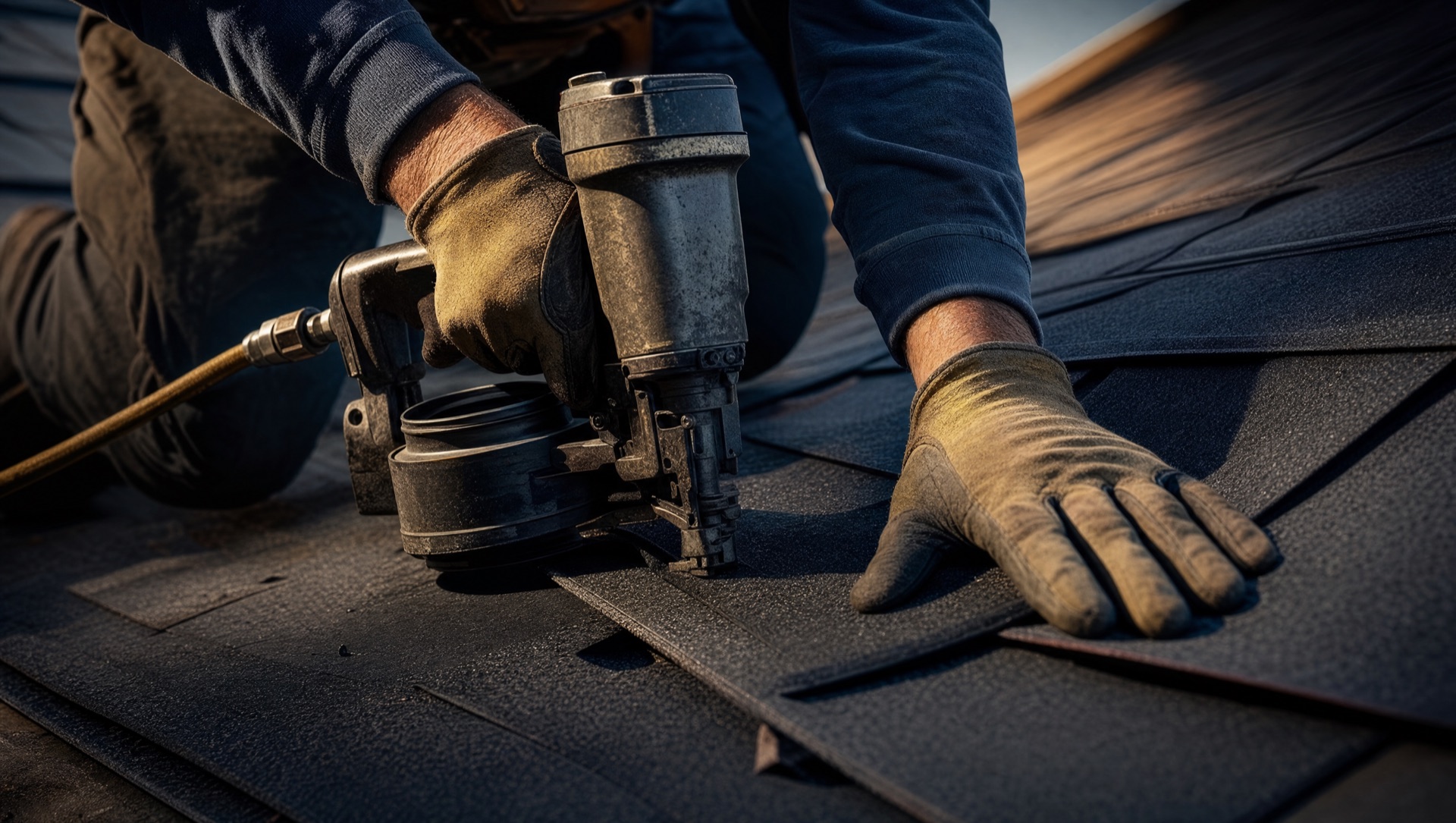
- The nailing zone. A marked band, usually about an inch tall, where fasteners must land so that they are covered by the course above. Nails high, low or overdriven void the wind rating regardless of what the packaging says.
- Laminated construction. An architectural shingle is two layers bonded together, which gives it depth, weight and a longer life than a single-layer three-tab.
Practical numbers: a roofing square is 100 square feet, and architectural shingles are normally packed three bundles to the square at somewhere around 70 to 80 pounds a bundle. A typical Maryland roof of about 24 squares is therefore in the region of two tons of material going up a ladder, which is worth remembering when comparing labour costs.
Are asphalt shingles good roofing?
Yes, for most Maryland houses, and the reason is cost per year rather than any single virtue. An architectural shingle roof lasts 25 to 30 years, is repairable, is available in every colour and profile, is understood by every roofer in the market, and satisfies every HOA. It is also the most forgiving product in an area where the weather cycles hard between freeze and humid heat.
| Asphalt shingle | The alternative | |
|---|---|---|
| Cost per year of service | Spread over 25 to 30 years, the best value on most houses. | Standing-seam metal lasts 40 to 70 years, so per year of service it is close to a wash — and better if you stay. |
| Complex rooflines | Excellent. Dormers, valleys and hips are routine and cheap to detail. | Metal gets expensive fast on a cut-up roof because every piece of trim is bent to fit. |
| Low slope | Not suitable below the manufacturer minimum pitch. | A low-slope membrane or a metal panel rated for the pitch. |
| Hail | Vulnerable. A Class 4 impact-rated shingle helps and does not make it immune. | Metal dents rather than fractures, and some policies exclude that as cosmetic. |
| Repairability | Easy while the product is still made and the roof is still supple. | Metal repairs are specialist work; membrane repairs are straightforward. |
The honest weakness of asphalt is that its performance depends more on installation than any other roofing product. The nail zone, the nail count, the starter course, the ventilation underneath and the flashing are all invisible once the roof is finished, and a poorly installed shingle roof looks identical to a good one from the street on the day it is completed. That is the entire reason the rest of these guides exist.
Shingle questions
How do shingles keep water out?
By shedding rather than sealing. Each course is laid overlapping the one below so any water landing on the roof runs from one shingle onto the next and off the edge, with gravity doing the work and nothing asked to hold water back. A heat-activated sealant strip bonds each course to the one beneath so wind cannot get under it. Below the shingles, underlayment acts as a secondary barrier that catches what gets past a detail, and ice-and-water membrane seals around fasteners at the eaves and valleys where water is most likely to be driven backwards.
Are asphalt shingles good for roofing?
For most Maryland houses, yes. An architectural asphalt roof lasts 25 to 30 years, handles complex rooflines cheaply, is repairable, comes in every colour, satisfies HOA requirements and is understood by every contractor in the market, which makes it the best cost per year available on a typical house. Its weaknesses are that it cannot be used below a minimum pitch, it is vulnerable to hail, and its performance depends more on installation quality than any other roofing product.
What is the nailing zone on a shingle?
A marked band across the shingle, usually about an inch tall, where fasteners are required to land. It is positioned so the nail is covered by the course above and so it passes through both layers of a laminated shingle. Nails placed above the zone are not covered and are exposed to water; nails placed below it miss the double layer and can tear through. Overdriven nails cut into the mat and underdriven ones hold the course off the deck. Nailing outside the zone voids the manufacturer wind rating, and it is invisible from the ground once the roof is finished.
How many shingles are in a square?
A roofing square is 100 square feet of roof area, and architectural shingles are normally packaged three bundles to the square, though some heavier designer profiles run four or five. A bundle typically weighs somewhere around 70 to 80 pounds. On a typical 24-square Maryland roof that is roughly two tons of material to be carried up and, in the case of the old roof, back down again.
What is the difference between three-tab and architectural shingles?
A three-tab shingle is a single layer cut into three tabs, giving a flat uniform look, a lighter weight, a lower wind rating and a service life of about 15 to 20 years. An architectural or laminated shingle bonds two layers together, which gives it a dimensional shadow line, considerably more weight, a higher wind rating and 25 to 30 years. Architectural is the standard specification on new work now, and three-tab survives mainly on outbuildings and on repairs to existing three-tab roofs.
Why do shingles need to seal down?
Because unsealed shingles are individual flaps and wind gets under them. The sealant strip is heat-activated: it softens in the sun after installation and bonds each shingle to the course below, turning the surface into a continuous bonded field. That bond is what wind ratings are measured against, and breaking it is what wind damage to a roof mostly is. It is also why a roof installed in cold weather may need hand-sealing, and why a roof that has never had a warm spell since installation can be more vulnerable than its rating suggests.
Where to go next
Now the products and the ratings, which are the next two questions people ask.
GAF, TAMKO, Owens Corning and CertainTeed compared
Four architectural shingles compared on wind coverage, algae warranty, nailing zone and price band.
Read the guide →RatingsShingle classes and impact ratings
What UL 2218 Class 4 and the ASTM wind classes actually test, and what a rating does not promise.
Read the standard →ScopeWhat is included in a roof replacement
Every line item in a full replacement, and the average cost per square.
See the numbers →ThesisWhy a roof fails at its details, not its field
Roofs rarely fail in the middle of a plane. They fail at edges, valleys, walls and penetrations.
Read the standard →The serviceRoof replacement
GAF architectural shingle or standing-seam metal, full tear-off, corrected ventilation, and a written line-item price first.
See the service →