Reviewed by Mohammad KhanCo-owner, United DevelopersMHIC #111971
What do starter strip and hip and ridge cap actually do?
Starter strip is a purpose-made first course at the eaves and the rakes. Its factory sealant line sits exactly where the first row of shingles needs to be bonded down, and its solid body covers the joints of the course above so wind-driven water has nothing to enter. Hip and ridge cap is a purpose-made shingle for the peaks: thicker, pre-scored, and formulated to bend in cold weather without cracking. The cheap substitute for both jobs is cutting the tabs off 3-tab shingles, which puts the adhesive in the wrong place, leaves the first-course joints unsealed at the most wind-loaded edge of the roof, and cracks at the fold. Substituted components also fall outside the component list manufacturers require for their strongest coverage.
Why wind attacks the edges
Air flowing over a roof does not stay attached to the surface. It separates at the eave, at the rakes and at the ridge, and separation creates suction — the pressures on a roof are highest at its perimeter and corners, not in the middle. Which is why a wind-damaged roof almost always shows the same pattern: the failure starts at an edge and progresses inward, shingle by shingle, as each newly exposed edge becomes the next one lifted.
Everything about the perimeter detailing is therefore about denying wind an edge to get under. That is the job of starter strip, and it is why the difference between a real starter and an improvised one is not a matter of finish quality. It is the difference between the first course being bonded and covered, and the first course being loose with open joints.
What a starter strip actually is
A purpose-made starter product does three things at once:
- It puts sealant in the right place. The factory adhesive line sits close to the eave edge, so the first course of shingles is bonded down along its most exposed edge. A shingle turned backwards, or a shingle with its tabs cut off, has its sealant line somewhere else — usually too high to bond the part that matters.
- It covers the joints of the course above. The first course of field shingles has cutouts and joints. Starter is a solid strip that sits under them, so any water that gets past a joint lands on more starter rather than on underlayment or deck.
- It gives a clean, straight, supported edge. The shingle overhang past the drip edge is consistent, and the edge is stiff rather than floppy.
The rake edge needs starter too
Ask most homeowners about starter and they picture the eave. The rake — the sloped gable edge — is a wind-uplift edge just as much, and on a gable-end house exposed to prevailing weather it may be the more important of the two. Rake starter, run up the edge with the sealant line at the outside, is the detail that keeps the field shingles from being peeled back like a page.
Purpose-made components versus cut-up shingles
| Purpose-made component | Cut-up 3-tab substitute | |
|---|---|---|
| Starter at eaves | Sealant line positioned to bond the first course near its exposed edge; solid body under the first-course joints. | Sealant in the wrong position, or absent along the edge that needs it. First-course joints sit over nothing. |
| Starter at rakes | A continuous stiff edge with sealant to the outside. | Usually simply omitted — the most common perimeter shortcut of all. |
| Hip and ridge cap | Thicker, pre-scored to fold cleanly, formulated to bend in cold without cracking. Matched to the field shingle’s profile and colour blend. | A 3-tab cut into three pieces. Single-layer, unscored, and prone to cracking at the fold in cold weather. |
| Appearance at the peak | A deliberate, deeper shadow line that reads as part of the design. | A thin, flat cap that visibly does not match a dimensional field shingle. |
| Cold-weather install | Designed to be folded over a ridge at low temperature. | Cracks at the fold, sometimes immediately, sometimes at the first hard freeze. |
| Manufacturer coverage | On the accessory list required for a manufacturer’s strongest warranty tiers. | Off the list. The substitution can affect which coverage the roof qualifies for. |
You can check the ridge from the ground. Stand back and look at the cap along your peaks and hips. Purpose-made cap has depth and a strong shadow line, and it matches the texture of the field shingles. Cut 3-tab cap is visibly thinner and flatter, and on a dimensional roof it looks like a different product — because it is.
The nailing zone, and why wind ratings are system claims
Shingles carry published wind ratings, tested to standards such as ASTM D3161 (Class A, D or F, where Class F corresponds to 110 mph) or ASTM D7158 (Class D, G or H, where Class H corresponds to 150 mph). Those numbers get quoted in sales conversations as if they were properties of the shingle. They are not. They are properties of the assembly: that shingle, fastened in the specified pattern, in the specified zone, with the specified starter, on a sound deck.
Three ways the fastening goes wrong
- Wrong count. Four fasteners per shingle is the common field minimum; six is required for higher wind exposure and for enhanced wind coverage on many products. Four nails on a roof sold as high-wind is a mismatch between the invoice and the physics.
- Outside the nailing zone. Every shingle has a designated strip where fasteners belong — on many laminated shingles a marked common bond area. A nail driven above it fastens only the upper layer and leaves the course below unsecured. This is the classic "high nailing" defect, and from the ground it is completely invisible.
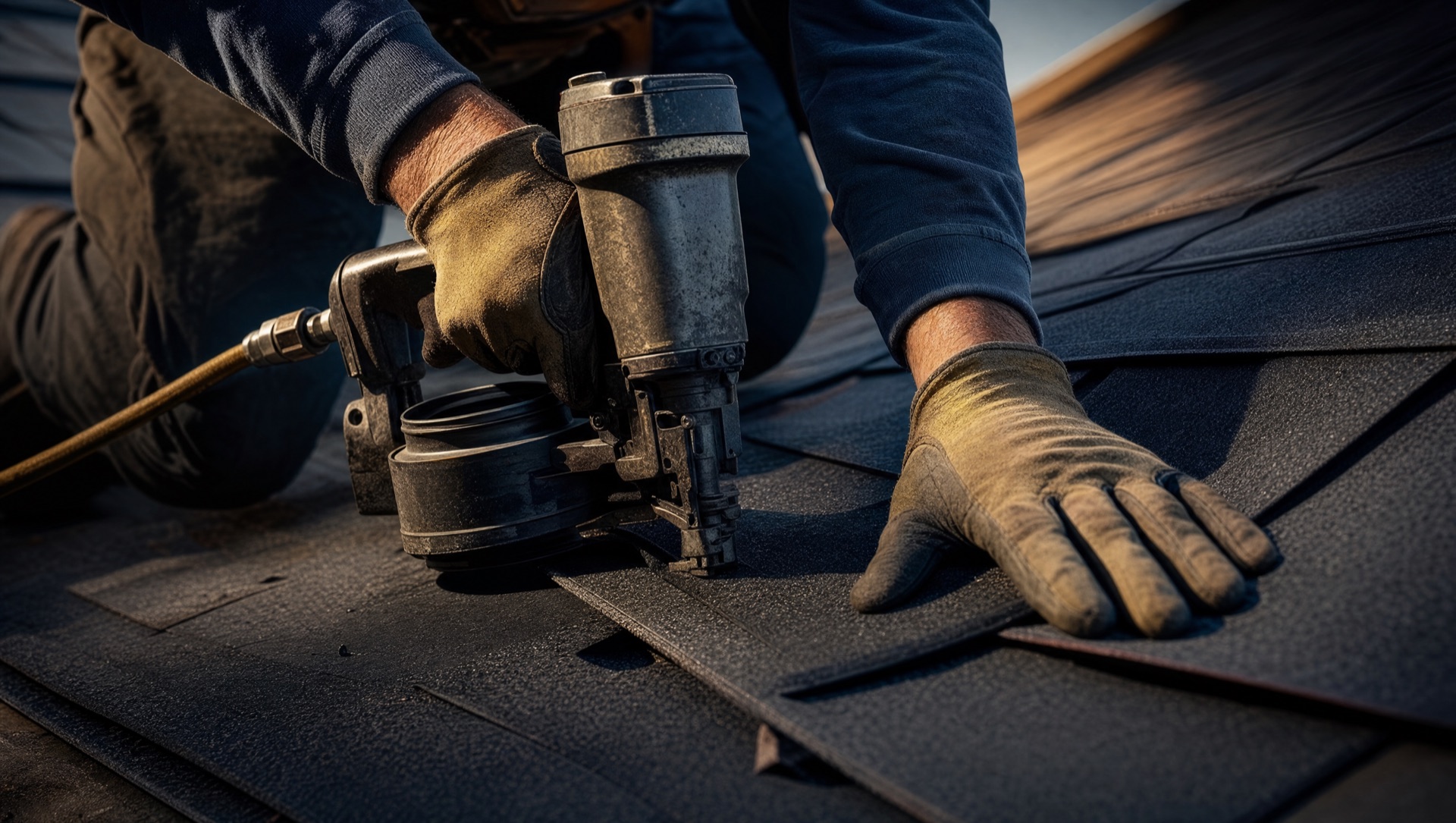
- Overdriven or underdriven. A nail driven through the mat cuts it and does not hold; a nail left proud lifts the shingle above it. Both come from an incorrectly set pneumatic gun, and both are systematic — if one is wrong, hundreds are.
Ask this question of any quote: how many fasteners per shingle, and what wind class does that pattern achieve on this product? A contractor who is fastening to the rated pattern will answer in one sentence. A contractor who is not will change the subject to shingle brand.
The ridge: cap and vent are one detail
At the peak, two jobs share the same six inches of roof. The cap has to shed water and resist uplift; the ridge vent has to let the attic exhaust. They are installed together, and the failure modes interact.
The cut slot
A continuous opening cut through the sheathing along the ridge, sized to the ridge vent being installed. This is the part that actually ventilates.
Fails when: Never cut, or cut narrower than the vent requires. A ridge vent over an uncut deck is decoration, and it is invisible from the ground.The ridge vent
A formed vent over the slot. External-baffle designs deflect wind up over the opening, which increases draw and resists wind-driven rain.
Fails when: Chosen without reference to the intake side. See attic ventilation.Hip and ridge cap
Purpose-made cap shingles over the vent and along every hip, fastened in the manufacturer’s line so the fasteners stay covered.
Fails when: Cut 3-tab tabs, or cap nailed outside the fastening line so heads sit exposed in the water path.Hip starter and terminations
The start of each hip and the ends of the ridge are detailed pieces, not offcuts. So are the transitions where a ridge meets a wall or a hip meets an eave.
Fails when: Improvised with sealant, which is where cap blows off first.What we specify, and why
The perimeter and the peak get named components, in writing
These items are cheap relative to the roof and decisive relative to its wind performance, which makes them the wrong place to save money and the right place to check a quote.
- Purpose-made starter at the eaves, named by product
- Purpose-made starter at the rakes — listed separately, because this is the one that gets dropped
- Purpose-made hip and ridge cap, matched to the field shingle, never cut 3-tab
- Fastener count per shingle stated, with the wind class that pattern achieves
- Fasteners in the manufacturer’s nailing zone, gun pressure set and checked
- Ridge slot cut to the vent’s specification and photographed open before cap goes on
- Hip starts, ridge ends and transitions detailed with components, not sealant
- System accessories from one manufacturer, so the roof qualifies for the coverage it was sold with
How to tell whether a contractor is cutting this corner
Ambiguous by design. Cutting the tabs off 3-tab shingles satisfies the phrase and puts the sealant line in the wrong place.
Ask instead: which starter product, at eaves AND at rakes, as two line items.Cut-up 3-tab tabs also count as ridge cap under that wording, and they crack at the fold in cold weather.
Ask instead: which hip and ridge product, matched to which field shingle.A wind class belongs to an assembly, not a product on its own. The rating assumes a specific fastener count, a specific nailing zone and a specific starter.
Ask instead: how many nails per shingle, and what class does that pattern achieve here?It is the common minimum. Higher wind exposure and enhanced wind coverage generally require six, and the difference is a few dollars of fasteners.
Ask instead: what does the manufacturer require for the wind class you just quoted me?A ridge vent only ventilates over a slot cut through the sheathing. Installed over an uncut deck it looks identical from the street.
Ask instead: for a photograph of the cut slot, open, before the cap goes on.Wind does. The rake is an uplift edge, and on a gable-end house facing prevailing weather it can matter more than the eave.
Ask instead: is rake starter included as a separate line?Starter and ridge questions DMV homeowners ask
What is a starter strip and do I really need one?
It is a purpose-made first course at the eaves and rakes, and yes. It does three things a field shingle cannot: it places a factory sealant line where the first course needs to be bonded near its exposed edge, it puts a solid strip under the joints and cutouts of that first course so water passing a joint lands on more starter rather than on underlayment, and it creates a stiff straight edge with consistent overhang. The common substitute, cutting the tabs off 3-tab shingles, gets the sealant position wrong and leaves the first-course joints unsupported at the most wind-loaded edge of the roof.
Is cut-up 3-tab ridge cap actually a problem?
Yes, in three ways. Purpose-made hip and ridge cap is thicker and pre-scored so it folds over a ridge cleanly, and it is formulated to bend at low temperature without cracking; a 3-tab cut into pieces is single-layer, unscored, and cracks at the fold, sometimes at the first hard freeze. It also looks wrong on a dimensional roof, because it is flat where the field shingle has depth. And substituted accessories generally fall outside the component list manufacturers require for their strongest warranty tiers, so the substitution can affect coverage as well as performance.
How many nails should each shingle get?
Four per shingle is the common field minimum, and six is generally required for higher wind exposure and for enhanced wind coverage on many products. What matters as much as the count is placement: every shingle has a designated nailing zone, and a fastener driven above it secures only the upper layer while leaving the course below unfastened. That defect is completely invisible from the ground. Ask for the fastener count in writing along with the wind class that pattern achieves on the specific product being installed.
Does the rake edge need starter as well as the eave?
Yes, and it is the one more often left out. The rake is the sloped gable edge, and it is a wind-uplift edge just as the eave is — on a gable-end house facing prevailing weather it can be the more critical of the two. Rake starter run up the edge with its sealant line to the outside is what stops the field shingles being peeled back from the edge inward, which is the pattern almost every wind-damaged roof shows. Ask for it as a separate line item so it cannot be quietly dropped.
What actually gives a shingle its wind rating?
The assembly, not the shingle alone. Ratings come from tests such as ASTM D3161, where Class F corresponds to 110 mph, and ASTM D7158, where Class H corresponds to 150 mph — and the tested configuration includes a specific fastener count, fasteners placed in the designated nailing zone, a specified starter at the perimeter, and a sound deck to hold them. Change any of those on your house and the published number stops describing your roof. That is why the fastening pattern belongs in the written scope next to the shingle name.
Where to go next
The components are only half the specification. The other half is the shingle itself, and what the ratings on its wrapper mean.
Shingle classes and impact ratings
3-tab, architectural and designer. Class 4 impact, wind and fire classes, and the truth about the 30-year shingle.
Read the standard →WarrantyWhat a roof warranty actually covers
Manufacturer versus workmanship, what limited lifetime really means, and what falls outside both.
Read the standard →ServiceRoof replacement in Maryland
Named starter at eaves and rakes, purpose-made hip and ridge, fastener pattern in the scope.
See the service →ToolSee your new roof
Put real shingle colours and profiles on your own house before you choose.
Try it →The serviceRoof replacement
GAF architectural shingle or standing-seam metal, full tear-off, corrected ventilation, and a written line-item price first.
See the service →